 (941) 924-6199
 6503 Gateway Ave., Gulf Gate,
Sarasota, FL 34231
6503 Gateway Ave., Gulf Gate,
Sarasota, FL 34231


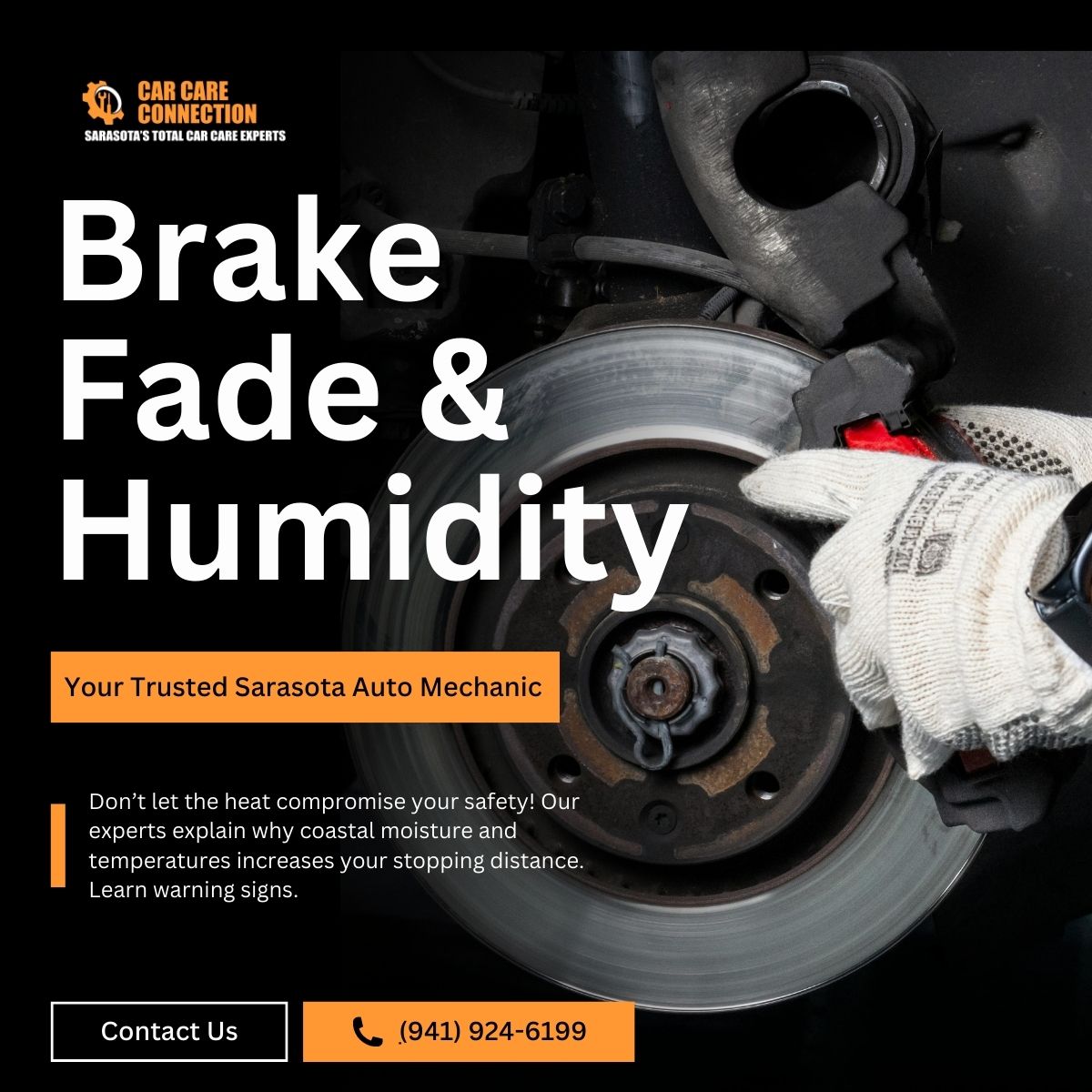
Brake Fade & Humidity: Why Your Stopping Distance Increases in Florida Summers
Florida’s summer humidity doesn’t just make you uncomfortable; it actively compromises your car’s braking system. In this guide, we explain the “hygroscopic” nature of brake fluid, how coastal moisture leads to a spongy pedal, and why your stopping distance increases when the temperature rises.
As the Sarasota mercury climbs, your vehicle’s braking system faces a double-front assault: extreme road surface temperatures and oppressive Gulf Coast humidity. If you’ve noticed your car doesn’t “bite” as hard as it used to, or the pedal feels soft during a summer afternoon commute on Fruitville Road, you aren’t imagining things. You are experiencing Brake Fade.
At our auto repair Sarasota shop, we see a significant spike in brake-related issues during the summer months. Understanding the science behind these failures is the first step toward staying safe on our busy seasonal roads.
Hygroscopic Hazards: The Invisible Threat in Sarasota Air
Most drivers know they need to check their brake pads, but very few consider the brake fluid. Brake fluid is “hygroscopic,” which is a scientific way of saying it acts like a sponge for moisture.
The Coastal Connection
In a high-humidity environment like Sarasota, moisture permeates the microscopic pores of your brake hoses and the seals of the master cylinder.
- The Boiling Point Problem: Brake fluid is designed to have a very high boiling point (often over 400 degrees Fahrenheit. However, water boils at just 212 degrees Fahrenheit.
- Vapor Lock: As you brake, the system generates intense heat. If your fluid is contaminated with water, that water turns into steam (gas). Unlike liquid, gas is compressible. When you hit the brakes, you are compressing steam rather than moving the brake calipers, resulting in that dangerous “spongy” or “sinking” pedal feel.
Expert Insight: In Florida, we recommend a brake fluid flush every 2 years regardless of mileage. This removes the accumulated moisture and restores your system’s hydraulic integrity.
The Science of Friction: Heat vs. Stopping Power
Braking is the process of converting kinetic energy (motion) into thermal energy (heat). When the ambient air is already 95 degrees, and the asphalt is 140 degrees, your rotors have a much harder time shedding that heat.
Performance Comparison: Standard vs. Overheated Conditions
| Component | Normal Conditions (70?F Ambient) | Florida Summer (95?F + Humidity) | Impact on Safety |
| Brake Pad Friction | Optimal “bite”; high coefficient of friction. | “Outgassing” can occur; pads glide on a thin layer of hot gas. | Increased Stopping Distance |
| Rotor Temperature | Rapid cooling between stops. | Heat “soaks” into the hub; metal remains expanded longer. | Higher Risk of Warping |
| Brake Fluid Status | Pure liquid; zero compressibility. | Potential for steam bubbles (vapor lock). | Spongy Pedal / Delayed Response |
Is your pedal feeling soft? Don’t wait for an emergency. Visit our Brake Repair Sarasota page to see how we restore your stopping power.
The Summer Safety Checklist: “Do This, Not That”
Identifying the root cause of a brake issue can be tricky. Use this expert “Do This, Not That” guide to determine if you’re dealing with warped rotors, worn pads, or fluid failure.
The “Do This, Not That” Diagnostic Guide
- DO THIS: If the steering wheel shakes when you brake at highway speeds, suspect warped rotors. The uneven surface is “kicking” the pads back, creating a vibration.
- NOT THAT: Don’t assume a vibration means you just need new pads. Replacing pads on warped rotors will only lead to premature pad wear and poor performance.
- DO THIS: If you hear a high-pitched squeal while driving that disappears when you touch the brakes, suspect worn pads. This is the mechanical wear indicator telling you the friction material is low.
- NOT THAT: Don’t ignore a “grinding” sound. Grinding means metal-on-metal contact. At this point, you are destroying your rotors and significantly increasing your risk of a collision.
- DO THIS: If the pedal goes to the floor at a red light, check your fluid immediately. This is a sign of a hydraulic leak or extreme moisture contamination.
Beyond brakes, your entire vehicle needs to be “summer-ready.” Check out our Auto A/C Repair South Sarasota services to stay cool while you stay safe.
Don’t Let the Heat Compromise Your Safety
Sarasota summers are unforgiving on your vehicle’s most important safety feature. Between the moisture in our air and the heat on our roads, your brakes are working twice as hard as they would anywhere else. Regular inspections and fluid flushes aren’t just maintenance; they are your primary defense against brake fade.
Is Your Car Ready for the Heat?
Schedule a Professional Brake Inspection Today and ensure your stopping distance is exactly where it needs to be. Visit our Coupons Page for special offers on brake fluid flushes and pad replacements!
