 (941) 924-6199
 6503 Gateway Ave., Gulf Gate,
Sarasota, FL 34231
6503 Gateway Ave., Gulf Gate,
Sarasota, FL 34231


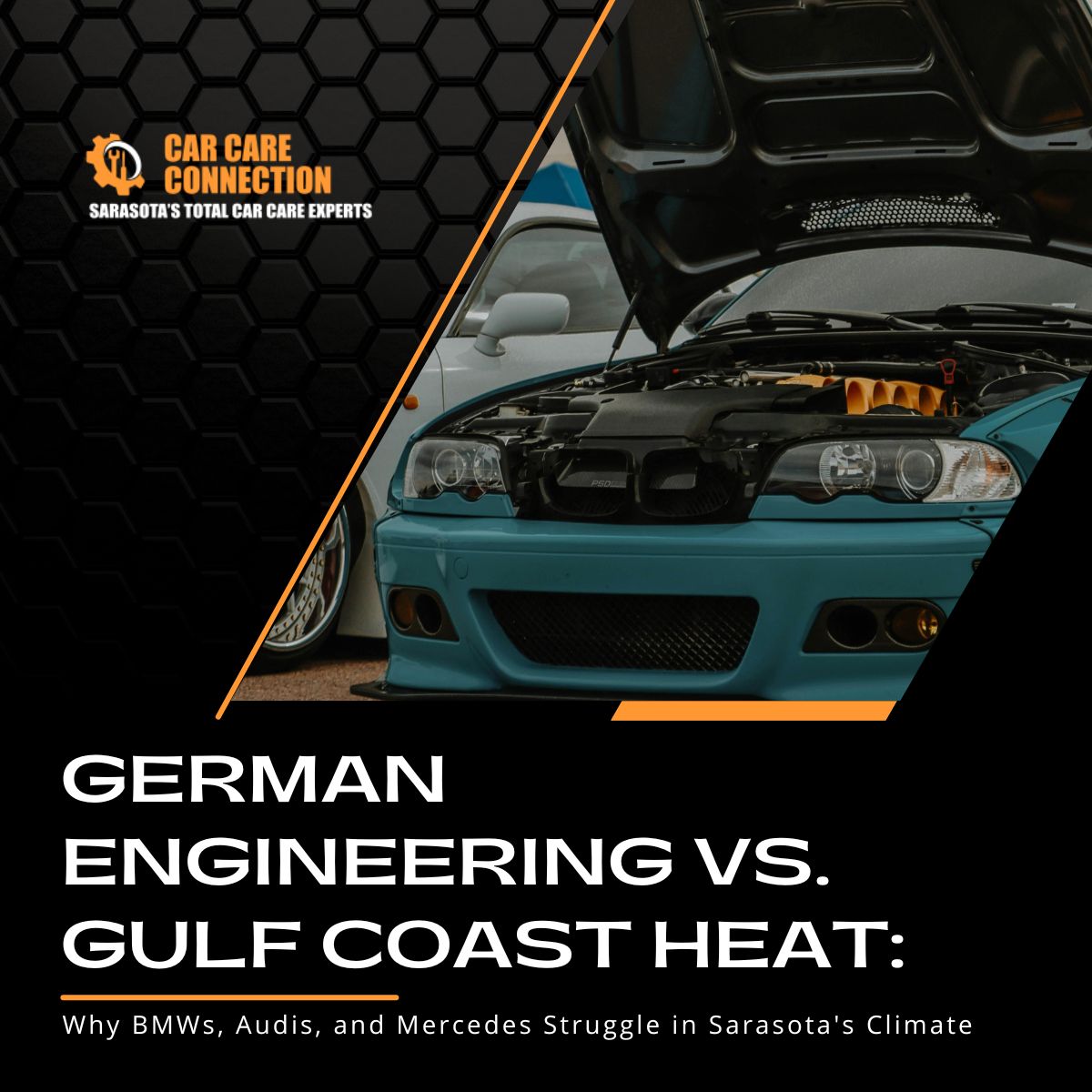
German Engineering vs. Gulf Coast Heat: Why BMWs, Audis, and Mercedes Struggle in Sarasota’s Climate
Florida’s heat and humidity don’t just wear you down; they wage war on your European vehicle’s most vulnerable components. In this post, our certified technicians break down the specific failure points we see most often in BMWs, Audis, and Mercedes here on the Gulf Coast, and why catching these issues early can save you thousands.
When German Precision Meets Florida Reality
There’s a reason drivers love European vehicles. The engineering is exceptional, with refined suspension systems, powerful turbocharged engines, and sophisticated electronics. BMW, Audi, and Mercedes-Benz build machines designed to perform at an elite level.
But “elite level” was largely engineered with Central European climates in mind. Not 95-degree Florida summers. Not the humidity that rolls off Sarasota Bay. Not the relentless UV exposure that bakes your hood from March through October.
The result? European vehicles driven on the Gulf Coast tend to develop specific, predictable failure patterns that we see regularly in our shop. The good news is that most of them are entirely preventable if you know what to watch for.
The Plastic Problem: Why European Cooling Systems Fail Prematurely Here
This is the single most common and most expensive issue we diagnose in European vehicles driven in Florida.
Unlike many domestic and Japanese vehicles that use metal components in their cooling systems, BMW, Audi, and Mercedes have historically relied heavily on plastic and polymer housings for coolant expansion tanks, water pump impellers, thermostat housings, and radiator end tanks.
In moderate climates, these components can last well over 100,000 miles. In Sarasota? We routinely see them beginning to degrade between 60,000 and 80,000 miles.
Here’s why: Plastic becomes brittle under sustained thermal stress. Every time your engine heats up and cools down, those polymer components expand and contract. Do that 300 days a year in extreme heat, and micro-fractures start to form. Add UV degradation from direct sun exposure, and you have a component that’s structurally compromised, often before it shows any external signs of failure.
Warning signs to watch for:
- White residue or crystalline buildup near coolant hoses or the expansion tank
- A sweet smell coming from your engine bay (that’s coolant, not a good sign)
- Your temperature gauge is creeping higher than normal, even briefly
- Visible cracking or warping on the coolant reservoir
- Any loss of coolant without an obvious external leak
According to our certified technicians, the most dangerous scenario isn’t a catastrophic burst; it’s a slow seep that goes unnoticed until the engine is already heat-stressed. On a BMW N54 or Mercedes M272 engine, an overheating event can warp cylinder heads, damage gaskets, and result in repair bills that exceed $4,000 to $8,000.
A coolant system inspection and proactive plastic component replacement? Typically, a fraction of that cost. Our European car repair services include full cooling system evaluations specifically designed for vehicles in high-heat environments.
Why Your Generic OBD-II Scanner Won’t Cut It
Here’s something most vehicle owners don’t know: the check engine light is just the beginning of the conversation, not the full story.
Generic OBD-II scanners, the kind you find at auto parts stores, are designed to read standardized fault codes across all makes and models. They’ll tell you something is wrong. What they won’t tell you is the complete picture your European vehicle is trying to communicate.
BMW, Audi, and Mercedes use proprietary diagnostic protocols that go far deeper than the universal OBD-II standard. Their systems monitor hundreds of parameters across the engine, transmission, suspension, airbag system, and advanced driver-assistance features. To access all of that, you need manufacturer-specific diagnostic software.
In our shop, we use professional-grade tools, including:
- ISTA (BMW’s Integrated Service Technical Application): reads BMW-specific fault paths, live data streams, and coding parameters that generic tools simply cannot access
- Autologic: a multi-brand European diagnostic platform that communicates with the full range of Audi, Mercedes, BMW, and other European manufacturer systems
A common scenario we see: a customer comes in after having their Audi scanned at a parts store. The code points to an oxygen sensor. They replace it. The problem persists. When we run it through Autologic, we find a secondary fault in the fuel trim system and a boost leak that the generic scan completely missed.
Accurate diagnosis isn’t optional; it’s the difference between fixing the problem once and chasing it for months. Learn more about our expert diagnostic services and why European vehicles require a different level of precision.
The Real Cost of Waiting: Prevention vs. Catastrophe
Let’s be direct about the math here, because we believe in transparency over salesmanship.
A proactive cooling system inspection and replacement of aging plastic components on a BMW or Mercedes typically runs in the range of a few hundred dollars, depending on the vehicle and what’s found. A thermostat housing, expansion tank, and coolant flush at the right mileage interval is routine, affordable maintenance.
An engine overheating event that warps a cylinder head or blows a head gasket? You’re looking at $3,000 on the low end and potentially engine replacement territory on high-mileage vehicles.
The same principle applies to diagnostics. Catching a fault code early, before it triggers secondary damage, costs a diagnostic fee. Ignoring warning signs until the transmission or fuel injection system compounds the issue costs multiples of that.
A simple prevention checklist for Gulf Coast European vehicle owners:
- Have your cooling system inspected every 30,000 miles or if the vehicle is approaching 60,000+ miles in Florida heat
- Never ignore a temperature gauge that reads higher than normal, even once
- Use only manufacturer-approved coolant (BMW, Audi, and Mercedes each specify different formulations)
- Always have warning lights diagnosed with European-specific software, not a generic parts store scan
- Ask your shop about proactive plastic component replacement on vehicles over 75,000 miles
Trust Your European Vehicle to Technicians Who Know It
German engineering is worth protecting. These are sophisticated, capable machines; they just need maintenance that respects what Florida’s climate puts them through.
At our shop, our ASE-certified technicians specialize in European makes and have the tools, training, and experience to keep your BMW, Audi, or Mercedes running the way it was designed to. We’re not guessing with generic equipment; we’re diagnosing with precision.
Ready to get ahead of cooling system or diagnostic issues before they become expensive emergencies?
Check out our current service coupons and schedule your inspection today. Your German-engineered vehicle deserves Gulf Coast-informed care.
