 (941) 924-6199
 6503 Gateway Ave., Gulf Gate,
Sarasota, FL 34231
6503 Gateway Ave., Gulf Gate,
Sarasota, FL 34231


Back-to-School Vehicle Checklist: What Sarasota Parents Should Inspect Before Their Teen Hits the Road
Vehicle mechanical failure is one of the leading contributors to teen driver crashes, and the five systems most likely to cause a roadside incident- brakes, tires, lights, battery, and AC- are also the five most commonly neglected on older family vehicles handed down to new drivers. For parents working with a trusted auto repair shop in Sarasota, a pre-school-year inspection is not an optional precaution. It is the clearest picture available of what condition your teen’s vehicle is actually in before they are driving it independently every day.
The Five Systems That Matter Most for Teen Driver Safety
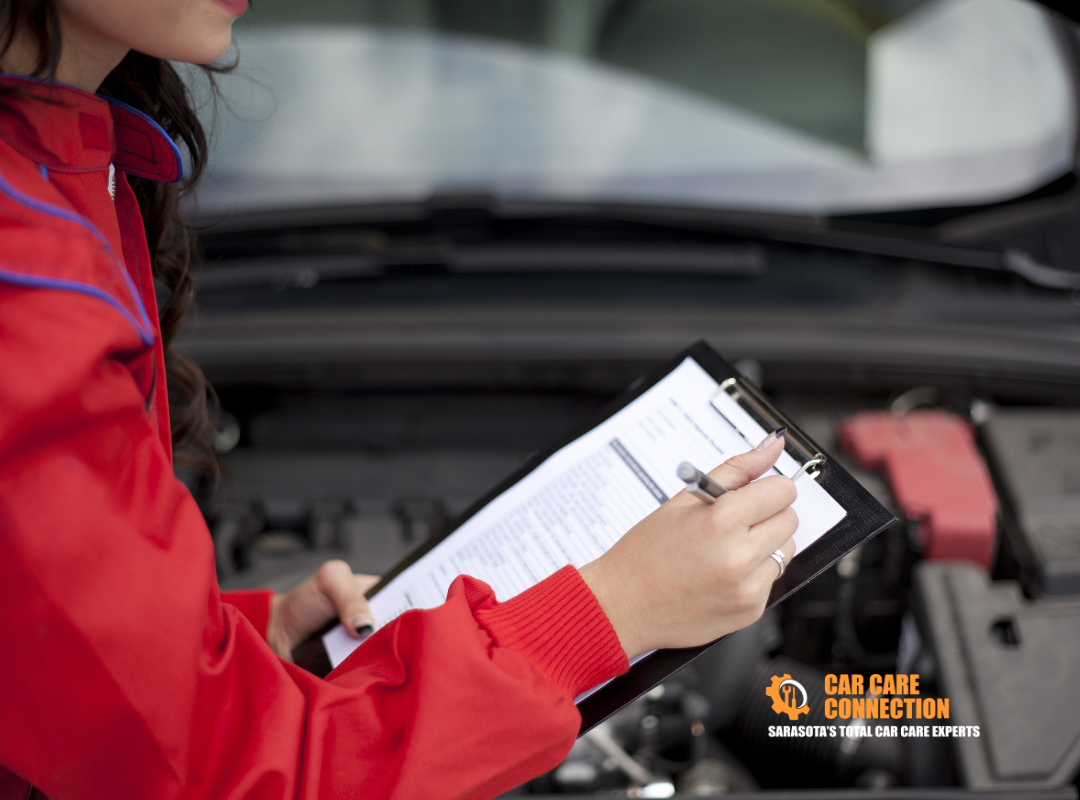
This is not a generic maintenance checklist. These are the five systems we see most often contribute to breakdowns and safety incidents in vehicles driven by new and young drivers and the ones where deferred maintenance creates the most risk.
1. Brakes
Brake system condition is the most safety-critical item on any vehicle, and it is the one that degrades most gradually. A teen driver who has never experienced the difference between a vehicle with healthy brakes and one with worn pads and scored rotors has no frame of reference to recognize that something is wrong. They adapt to the longer stopping distances without realizing the system is compromised.
A brake inspection before the school year should cover pad thickness, rotor condition and minimum thickness spec, caliper function and slide pin condition, brake fluid moisture content, and hose integrity. Pad thickness alone is not a complete picture. Our professional brake inspection service covers all of these components because a measurement without context does not indicate what the system will do under emergency braking conditions.
2. Tires
Tire condition involves more than tread depth, and this is where parent inspections most commonly miss something critical. Florida’s UV exposure and heat accelerate sidewall oxidation. A tire that has adequate tread depth can still have compromised sidewall integrity from age and sun exposure, which technicians call dry rot. Cracking along the sidewall is not cosmetic. It indicates that the rubber has lost structural integrity and is at elevated risk of failure under highway load.
Check tread depth, but also check the sidewalls and the tire’s age. The DOT code on the sidewall includes the week and year of manufacture. A tire more than six years old in Florida’s climate deserves scrutiny regardless of how much tread remains. Also verify that all four tires are inflated to the vehicle manufacturer’s specification, not the maximum pressure listed on the tire sidewall, which is not the same number.
3. Battery
Florida heat shortens battery life significantly compared to temperate climates. A battery that passes a basic voltage check can still fail under sustained load, the kind of load produced by running AC, headlights, and a phone charger simultaneously, which is how a teen vehicle operates on every drive.
If the battery is approaching three years old, a load test is the only way to know whether it has adequate reserve capacity. A load test applies a simulated electrical draw and measures whether voltage holds within acceptable range. A battery that fails under load will not give a reliable warning before it leaves a new driver stranded. This is one of the most straightforward and underutilized pre-season checks available.
4. Lights
A complete lighting check takes less than five minutes and requires only one other person. Walk around the vehicle with all lights operating: low beam headlights, high beams, brake lights (have someone press the pedal), turn signals front and rear, reverse lights, and hazard flashers. A burned-out brake light is a rear-end collision risk in heavy Sarasota traffic. A headlight out reduces visibility and draws police attention. Both are preventable with a two-minute check before the school year begins.
5. Air Conditioning
In South Sarasota, AC is not a comfort item; it is a safety consideration. A teen driving to school in August without functioning AC faces heat stress that affects reaction time and decision-making. If the system is not blowing cold or is cycling inconsistently, have it inspected before school starts. The demand on Sarasota AC service shops peaks in July and August, which means scheduling in advance is worth doing.
The Hand-Me-Down Vehicle Problem
The most common scenario we see is a parent’s older vehicle — four to eight years old, somewhere between 80,000 and 130,000 miles, being transitioned to a teen driver. The vehicle has been reliable for the family, which creates confidence that it is ready for its next use. In most cases, that confidence is reasonable. But “reliable for an experienced driver who knows how the car feels” and “safe for a new driver who does not know what normal feels like” are not the same standard.
Older family vehicles often carry deferred maintenance that an experienced driver has learned to manage, a slight pull that gets compensated for in steering, a brake pedal that requires a bit more pressure than it used to, tires that are getting close but not yet at the wear bars. A new driver does not know to compensate for any of these things. They drive the vehicle as though it is operating correctly because they have no basis for comparison.
A pre-school-year inspection on a hand-me-down vehicle is not about finding problems. It is about knowing the vehicle’s actual condition so that any items requiring attention can be addressed before a new driver is behind the wheel independently.
For vehicles with under 50,000 miles, it is also worth asking about the BG Lifetime Protection Plan, a coverage program available through Car Care Connection that provides documented engine and fuel system protection for qualifying vehicles maintained on a BG service schedule.
What a Pre-School-Year Inspection Actually Covers
A multi-point inspection at Car Care Connection is a documented assessment of the vehicle’s condition across all major systems. It is not a sales exercise. The output is a clear picture of what is within spec, what is approaching service interval, and what requires immediate attention, with the parent making the decision about how to proceed.
Here is what that process covers:
| System | What We Check | What We’re Looking For |
|---|---|---|
| Brake System | Pad thickness, rotor condition, caliper function, fluid, hoses | Wear below safe threshold, scoring, moisture contamination, cracking |
| Tires | Tread depth, sidewall condition, age, pressure | Dry rot, uneven wear patterns, age over 6 years, incorrect inflation |
| Battery | Voltage and load test, terminal condition, age | Inadequate reserve capacity under load, corrosion, approaching 3-year threshold |
| Lights | All exterior lighting functions | Burned-out bulbs, lens damage, aim issues |
| Air Conditioning | Output temperature, system pressure, blower function | Refrigerant loss, compressor cycling issues, cabin filter restriction |
| Wheel Alignment | Four-wheel alignment angles vs. manufacturer spec | Toe, camber, or caster deviation causing pull or accelerated tire wear |
| Fluids | Engine oil, coolant, transmission, power steering, brake fluid | Level, condition, contamination, service interval status |
| Belts and Hoses | Serpentine belt, radiator hoses, AC hoses | Cracking, glazing, swelling, clamp condition |
The inspection produces a written report. Parents leave knowing exactly where the vehicle stands, not with a list of recommended services, but with documented findings they can use to make informed decisions. For a full overview of our repair and service capabilities, visit our complete auto repair services page. We also offer wheel alignment service as part of a comprehensive pre-school-year check when tire wear patterns suggest it is needed.
Frequently Asked Questions
What should I check on my teen’s car before school starts?
The five highest-priority systems are brakes, tires, battery, lights, and AC. Brakes and tires directly affect stopping distance and vehicle control. Battery failure is the most common cause of a new driver being stranded. Lights are a legal safety requirement and a rear-end collision risk if any are out. AC is a safety consideration in Florida’s August heat. A professional multi-point inspection covers all of these systems and provides a documented baseline for the vehicle’s condition.
How do I know if a used or older car is safe for a teen driver?
The most reliable way is a professional inspection that goes beyond a visual walkthrough. An experienced technician will measure brake pad and rotor thickness against manufacturer minimums, load-test the battery rather than just checking voltage, inspect tire sidewalls for age-related degradation, and check alignment angles against factory specification. A vehicle that has been driven reliably by an adult may still have deferred maintenance that a new driver is not equipped to recognize or manage.
How much does a pre-school-year vehicle inspection cost?
A multi-point inspection at Car Care Connection is typically included as part of a scheduled service visit. As a standalone service, the cost is modest compared to what a single roadside incident, tow, emergency repair, and potential insurance implications typically run. The value of the inspection is not in what it costs but in what it prevents. Check our current service offers before you schedule.
What is the biggest safety risk in a hand-me-down car for a teen?
In our experience, the three systems most likely to create a safety incident in a hand-me-down vehicle are brakes (worn pads or scored rotors that an experienced driver has adapted to), tires (sidewall degradation from age and Florida UV exposure that is not visible from a quick glance), and the battery (which may pass a voltage check but fail under sustained load). All three degrade silently and without obvious warning signs until they fail, which is exactly why a professional inspection before handing over the keys matters.
