 (941) 924-6199
 6503 Gateway Ave., Gulf Gate,
Sarasota, FL 34231
6503 Gateway Ave., Gulf Gate,
Sarasota, FL 34231


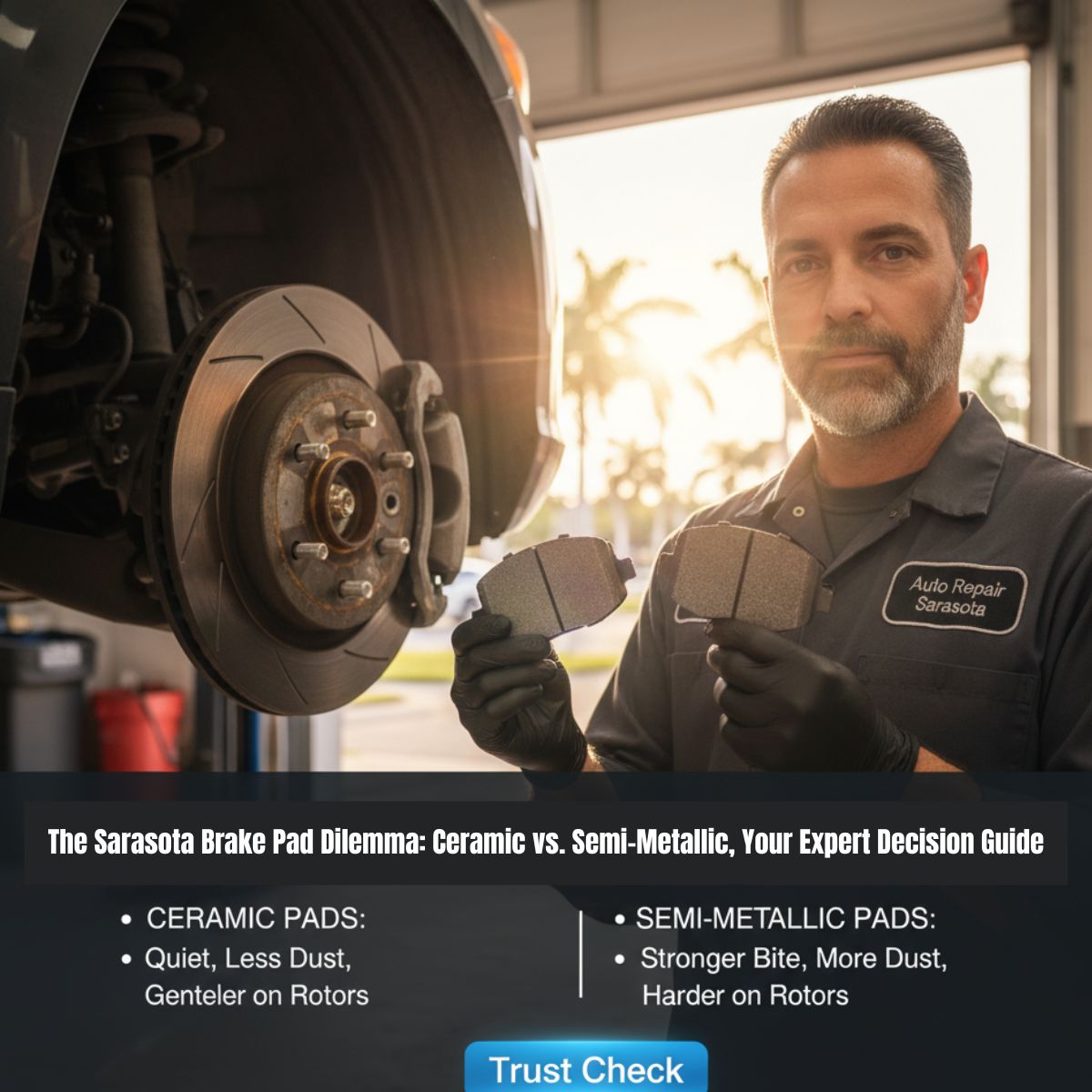
The Sarasota Brake Pad Dilemma: Ceramic vs. Semi-Metallic, Your Expert Decision Guide
TL;DR: Choosing the right brake pad, Ceramic or Semi-Metallic, is the most important decision during a brake repair in Sarasota. This expert guide from our certified brake technicians cuts through the noise, detailing how each material affects performance, longevity, and dust in Florida’s humid, heavy-traffic environment. We also give you the authority-backed facts on rotor replacement vs. resurfacing.
Your ability to stop reliably is the single most critical factor in vehicle safety. As your trusted local experts for auto repair in Sou
th Sarasota, we understand that when you need brake repair Sarasota, you’re looking for peace of mind, not just a quick fix.
The quality and type of friction material used in your brake pads is essential. The right choice depends on your vehicle’s specifications, your driving style, and your priorities (such as a quieter cabin or minimal wheel dust).
1. Friction Fact-Check: What’s Under the Hood?
Brake pads harness friction to transform your car’s forward motion (kinetic energy) into heat, safely slowing you down. The core material dictates how effectively that heat is managed and what byproducts (like noise and dust) are produced.
| Aspect | Ceramic Brake Pads (The Quiet Choice) | Semi-Metallic Pads (The Workhorse) |
| Composition | Primarily hard ceramic fibers, filler material, and advanced bonding agents. | A high percentage of metal (30-65% iron, copper, steel) mixed with organic fillers. |
| Stopping Power | Delivers excellent, highly consistent braking performance under most conditions. | Exceptionally strong stopping power, favored for trucks, heavy SUVs, and aggressive driving. |
| Rotor Integrity | Significantly Gentler on rotors, promoting maximum lifespan before replacement is required. | More Abrasive on the rotor surface due to high metal content, accelerating rotor wear over time. |
| Acoustics (Noise) | Engineered for silence; they are nearly always quiet under daily use. | Prone to higher noise levels, including occasional squeals, particularly in cold or damp conditions. |
| Aesthetic (Dust) | Produces light, fine dust that is easy to wipe away and less noticeable on alloy wheels. | Generates heavy, dark brake dust that sticks aggressively and can quickly stain wheels. |
| Local Recommendation | Ideal for the majority of Sarasota drivers: daily commuters seeking quiet performance and clean wheels in stop-and-go traffic. | Best suited for large SUVs, trucks, towing vehicles, or certain European models that require the highest initial bite. |
Expert Insight from Our Technicians: In a coastal city like Sarasota, where humidity and short trips are common, high-quality ceramic pads often deliver the best return on investment for daily drivers, balancing reliable stopping power with reduced noise and maintenance.
2. Rotor Health: Replacement vs. Safe Machining
When you service your pads, the rotors (or brake discs) must be evaluated. Rotors absorb and dissipate tremendous amounts of heat, and their structural integrity is non-negotiable for safety.
The Authority Check: When to Replace
At our auto repair shop Sarasota, our decision to resurface (machine flat) or replace a rotor is governed strictly by manufacturer specifications and safety:
Rotor Thickness Variation (RTV) and Minimum Limits
Every rotor has a minimum thickness specification etched into its hub. This is the thinnest point it can reach safely.
- Resurfacing Decision: If the rotor is warped (which causes your brake pedal to pulse or shimmy) but can be machined flat while remaining above the minimum thickness mark, resurfacing is a safe, economical choice.
- Mandatory Replacement: If the rotor is grooved, cracked, or if restoring flatness would drop the thickness below the minimum safety threshold, it must be replaced. A thin rotor cannot handle the heat and pressure, dramatically increasing the risk of structural failure.
Key Takeaway (Prioritizing Safety): We will never machine a rotor past its safe limit. If a rotor is borderline, our certified technicians will always recommend replacement. Choosing safety now prevents premature failure and far more expensive repairs down the road.
What to Avoid: Allowing a repair shop to “cheat” the thickness specification. This drastically compromises your vehicle’s heat dissipation and, most importantly, your emergency stopping power.
If your brake pedal shimmies or pulses when braking at highway speeds, it’s a classic sign of warped rotors. Get ahead of the issue by scheduling a thorough brake inspection today
3. The Trust Check: Your 3-Step Brake Inspection Guide
We believe transparency builds trust. A professional brake inspection at our facility is not a quick visual check; it’s a comprehensive, step-by-step guide to your entire stopping system.
A. Initial Diagnosis: Diagnosing the Sound
Step 1: Our technician begins with a complete road test. We listen for specific auditory cues that indicate the nature and severity of the problem:
- Squealing: Often the warning sound emitted by the pad’s built-in wear indicator (a small metal tab). This means immediate service is required.
- Grinding: The dangerous noise of metal-on-metal. This means the pads are completely gone. Stop driving and call for a tow immediately.
- Pulsation (Shimmy): Usually indicates Rotor Thickness Variation (warping) that you feel through the pedal or steering wheel.
B. The Mechanical Assessment
Step 2: Once the wheels are removed, the technician assesses the hard components:
- Pad & Rotor Assessment: Measuring current pad thickness and verifying the rotor thickness against manufacturer specifications.
- Calipers & Slides: Verifying that the brake calipers move freely and are not seized up, a common cause of uneven pad wear and vehicle pulling.
C. The Fluid Health Check
Step 3: The braking system relies entirely on hydraulic pressure:
- Brake Fluid Condition: We visually inspect the fluid for clarity and, crucially, test it for moisture contamination. Brake fluid is hygroscopic (absorbs water), which lowers its boiling point, compromises stopping performance, and causes internal corrosion of expensive components.
Ready for Reliable Stopping Power?
If you have any doubt about the safety or performance of your brakes, do not postpone service. Your safety and the safety of your passengers depend on a fully functional braking system.
To understand our full scope of brake services, from fluid flushes to complete caliper replacement, visit our pages on Brake Replacement and General Brake Repairs.
Call us today or click below to schedule your service.
