 (941) 924-6199
 6503 Gateway Ave., Gulf Gate,
Sarasota, FL 34231
6503 Gateway Ave., Gulf Gate,
Sarasota, FL 34231


Oil Change in Sarasota: Synthetic vs. Conventional – Which One Is Right for Your Vehicle and Florida’s Climate?
Full synthetic oil outperforms conventional in high-heat environments by maintaining viscosity stability at sustained temperatures that routinely exceed what most owner’s manuals were written to address. For drivers scheduling an oil change in Sarasota, that distinction matters more than it does almost anywhere else in the country. Florida’s year-round heat, combined with the constant demand of running AC through stop-and-go coastal traffic, puts engine oil under conditions that separate quality lubricants from adequate ones, every single day.
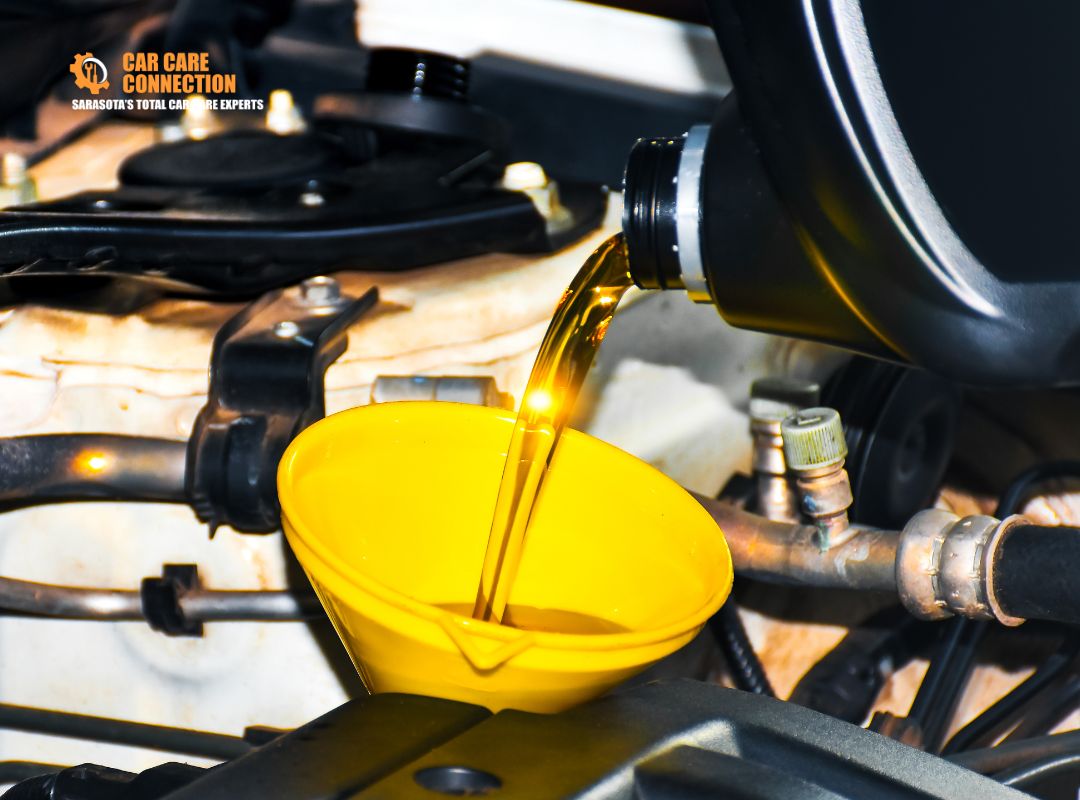
Why Oil Choice Matters More in Florida Than Most States
Engine oil does two things: it lubricates moving parts to prevent metal-on-metal contact, and it carries heat away from critical engine components. As oil temperature rises, its viscosity drops. Thinner oil forms a weaker protective film between engine parts. In a temperate climate with seasonal cold starts, the oil spends a significant portion of its life operating below peak temperature stress. In Sarasota, that buffer does not exist.
Vehicles here run hot from the moment the engine starts. The AC compressor adds load. Traffic on US-41 and Stickney Point Road means frequent low-speed, high-RPM operation. Oil that performs adequately in a Chicago winter or a Denver spring is working at the edge of its envelope during a Sarasota July.
Full synthetic oil is engineered with a more uniform molecular structure than conventional oil. That uniformity translates directly to better viscosity retention under heat, better resistance to oxidation, and a longer functional lifespan. For vehicles operating year-round in South Sarasota’s climate, it is the more protective choice in the vast majority of cases.
When Conventional Oil Is Still the Right Answer
Conventional oil is not obsolete. For older, high-mileage vehicles, it can actually be the more appropriate choice. Engines with significant wear on seals and gaskets sometimes benefit from the slightly higher viscosity that conventional oil maintains at operating temperature. Switching an older engine to full synthetic can occasionally surface leaks that the conventional oil was effectively sealing through viscosity alone.
The right oil for your vehicle depends on the engine’s age, its mileage, its current condition, and the manufacturer’s specifications. A blanket recommendation for either type without considering those factors is not a diagnosis — it is a guess. This is one of the reasons a conversation with a technician who knows your vehicle’s history is worth more than an oil type recommendation from an algorithm.
Synthetic vs. Conventional: A Side-by-Side Comparison
| Factor | Full Synthetic | Conventional |
|---|---|---|
| Heat resistance | Excellent — retains viscosity at sustained high temps | Moderate — thins faster under prolonged heat |
| Change interval | Typically 7,500–10,000 miles | Typically 3,000–5,000 miles |
| Cold start protection | Superior — flows faster at startup | Adequate for most conditions |
| Oxidation resistance | High — breaks down slower over time | Lower — degrades faster in heat cycling |
| Best for | Modern engines, Florida climate, AC-intensive driving | Older engines, high-mileage vehicles with seal wear |
| Cost per service | Higher upfront, fewer services per year | Lower upfront, more frequent changes required |
The 3,000-Mile Myth: Why It Still Costs Sarasota Drivers Money
The 3,000-mile oil change interval was established decades ago for conventional oil formulations that no longer represent the current standard. Modern full synthetic oils, combined with today’s engine tolerances and filtration systems, do not require that frequency. Most manufacturers specify 5,000 to 10,000 miles for synthetic, with some turbocharged or performance applications falling on the shorter end of that range.
Changing oil more frequently than necessary does not add protection. It adds cost. A driver changing synthetic oil every 3,000 miles is paying for two or three extra services per year that provide no engineering benefit. Over the life of vehicle ownership, that adds up to a significant unnecessary expense.
The common mistake here is conflating “more frequent” with “more protective.” With modern synthetic oil and a properly functioning engine, the interval in your owner’s manual is the right target. If your vehicle has specific conditions, towing, extensive idling, extreme heat cycling, those warrant a conversation, not a blanket reduction to 3,000 miles.
What Neglected Oil Changes Actually Do to an Engine
Oil does not simply stop lubricating when it gets old. The degradation is gradual, and that is part of what makes it easy to ignore. Here is what the process actually looks like over time.
As oil ages, heat cycling causes oxidation. The oil thickens and begins to form deposits on internal engine surfaces. These deposits restrict oil flow through narrow passages, including the channels that supply the camshaft, lifters, and bearings. Components that depend on a consistent film of clean oil begin operating with less protection than they were designed for.
In the early stages, the effect is reduced fuel economy and slightly elevated operating temperatures. Neither is dramatic enough to trigger a warning light. The engine runs, but it is working harder than it should. Over time, without fresh oil to clean and coat internal components, sludge accumulates. Sludge is not a minor inconvenience, it is a direct path toward bearing wear, lifter failure, and in severe cases, engine seizure.
The comparison that matters is not between two oil change intervals. It is between the cost of routine oil service and the cost of an engine repair or replacement. The gap between those two outcomes is wide, and consistent oil service is almost entirely what separates them.
Our team at Car Care Connection approaches every oil service as a complete under-hood check, not just a fluid swap. For a full picture of what that process covers, visit our vehicle maintenance services page. And if your vehicle has developed any symptoms — oil consumption, unusual engine noise, or reduced performance, our auto repair services page covers the diagnostic and repair process in detail.
To learn more about who we are and how we work with Sarasota drivers, visit our about us page.
Frequently Asked Questions
Is synthetic oil worth it for Sarasota driving?
For most modern vehicles in South Sarasota, yes. Full synthetic maintains viscosity more effectively under sustained heat, resists oxidation longer, and provides better protection during the extended AC-on driving that Florida’s climate demands. The higher per-service cost is offset by fewer changes per year and better long-term engine protection.
How often should I get an oil change in Florida?
With full synthetic oil, most vehicles fall in the 7,500-to-10,000-mile range per manufacturer specification. Conventional oil typically requires service every 3,000 to 5,000 miles. Florida’s heat means you should stay toward the more frequent end of whichever interval applies to your oil type and vehicle. When in doubt, check your owner’s manual and discuss your driving conditions with your technician.
Can I switch from conventional to synthetic oil?
In most cases, yes. Modern synthetic oils are fully compatible with conventional-oil engines, and switching does not require any special flush or preparation. The exception is older, high-mileage engines with significant seal wear — in those cases, the switch should be discussed with a technician who can assess whether synthetic viscosity characteristics are appropriate for that specific engine’s condition.
What happens if I go too long between oil changes in Florida?
Extended intervals accelerate oil oxidation and sludge formation, both of which are worsened by Florida’s heat cycling. The effects build gradually — reduced fuel economy and elevated operating temps first, followed by increased wear on bearings, lifters, and other oil-dependent components. Consistent service on interval is the most reliable way to avoid those outcomes.
