 (941) 924-6199
 6503 Gateway Ave., Gulf Gate,
Sarasota, FL 34231
6503 Gateway Ave., Gulf Gate,
Sarasota, FL 34231


Brake Fluid Flush in Sarasota: The Maintenance Step Most Drivers Skip and Why It Matters More in Florida
Brake fluid is hygroscopic; it actively absorbs moisture from the surrounding air, and in Sarasota’s year-round coastal humidity, that process happens faster than in any temperate climate, degrading the fluid’s boiling point and increasing brake fade risk with every mile driven on old fluid. For drivers seeking brake repair in Sarasota, understanding what brake fluid actually does and why it degrades is the difference between a routine maintenance visit and a brake system failure that could have been prevented.
What Brake Fluid Does and Why Moisture Is the Problem
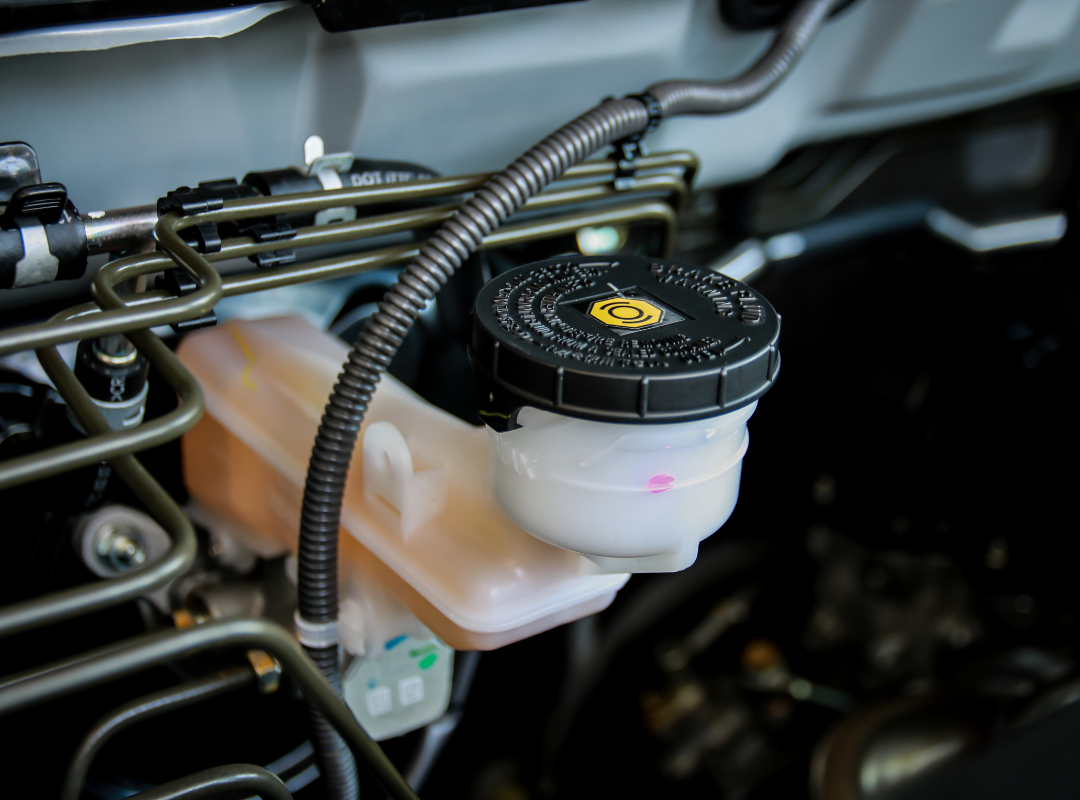
Brake fluid transmits the hydraulic pressure generated when you press the brake pedal through the brake lines to the calipers at each wheel. It is the medium that converts foot pressure into stopping force. For that system to work correctly, the fluid must remain incompressible under pressure and stable under heat.
The hygroscopic property of brake fluid is the complicating factor. Glycol-based brake fluids, which include DOT 3, DOT 4, and DOT 5.1, absorb moisture through microscopic permeation in rubber brake hoses and at reservoir seals. This is not a defect. It is an engineered characteristic that prevents water from pooling in low points of the brake system where it could cause corrosion or freeze. The tradeoff is that the fluid itself becomes progressively contaminated with water over time.
Water has a boiling point of 212°F. Fresh DOT 3 fluid has a dry boiling point of at least 401°F. A brake fluid sample with only 3.7 percent water content can see its boiling point drop to around 284°F. In a Florida vehicle running hard braking in summer stop-and-go traffic, the kind of driving that characterizes US-41 and the Siesta Key causeway approach in peak season, that degraded boiling threshold becomes a functional safety concern.
Brake Fade: What Happens When the Fluid Boils
Brake fade from fluid vaporization is called vapor lock. Here is what it feels like in practice.
A driver navigating repeated hard stops in slow summer traffic notices the brake pedal feels normal for the first several stops. Then, after sustained use, the pedal begins to feel soft or spongy. Stopping distances increase. The driver applies more pedal pressure and gets less response than expected. In a severe case, the pedal travels further toward the floor before the brakes engage effectively.
What is happening mechanically is that the degraded fluid, with its lowered boiling point, has reached its vaporization threshold under the heat generated by repeated hard braking. Vapor, unlike liquid, is compressible. When vapor forms in the brake lines or caliper, pressing the pedal compresses that vapor rather than transmitting hydraulic force to the caliper pistons. The result is the spongy pedal and reduced stopping force the driver is experiencing.
This is not a theoretical scenario. It is the predictable outcome of running brake fluid past its service life in a high-heat, high-humidity environment. Florida’s climate accelerates the moisture absorption timeline compared to what the vehicle manufacturer’s interval was designed around — which is typically a moderate climate with seasonal variation that Sarasota simply does not have.
DOT 3, DOT 4, and DOT 5.1: Which Fluid Does Your Vehicle Require?
Most drivers do not know their vehicle has a specified brake fluid type. The DOT rating is printed on the brake fluid reservoir cap, and it matters more than most fluid specifications because using the wrong type — or mixing types incorrectly — can compromise system integrity.
| Fluid Type | Dry Boiling Point | Wet Boiling Point | Common Application |
|---|---|---|---|
| DOT 3 | 401°F minimum | 284°F minimum | Older domestic vehicles, basic brake systems |
| DOT 4 | 446°F minimum | 311°F minimum | Most modern vehicles, European makes, performance applications |
| DOT 5.1 | 500°F minimum | 356°F minimum | High-performance and heavy-duty applications |
| DOT 5 | 500°F minimum | 356°F minimum | Silicone-based – not compatible with glycol systems; specialty use only |
DOT 3, 4, and 5.1 are glycol-based and are generally compatible; DOT 4 can be used in a DOT 3 system, for example. DOT 5 is silicone-based and is not compatible with glycol systems. Mixing DOT 5 into a glycol system causes the fluid to gel and can destroy seals throughout the brake system. This is not a minor mistake.
The correct fluid specification for your vehicle is in the owner’s manual and on the reservoir cap. A technician who performs a brake fluid flush should be verifying that specification before any fluid goes into the system.
How Often Should Brake Fluid Be Flushed in Florida?
Most manufacturer recommendations fall in the two-to-three year or 30,000-mile range. Those intervals were developed for moderate climates. Florida’s coastal humidity means moisture absorption happens at an accelerated rate, which argues for the shorter end of whatever interval the manufacturer specifies, or an annual fluid test that measures moisture content directly.
A brake fluid test strip or refractometer can measure the water content percentage in the existing fluid and provide an objective basis for the service decision. This is the approach we use at Car Care Connection: test the fluid condition, show the reading, and let the data drive the recommendation rather than a calendar interval alone.
For drivers who have not had brake fluid serviced in more than two years or 25,000 miles, the fluid condition should be checked as part of any brake system inspection. Our brake fluid flush and replacement service covers a complete system drain, fresh fluid to manufacturer specification, and a post-service bleed to confirm proper pedal feel and pressure.
Brake Fluid as Part of a Complete Brake System Evaluation
Brake fluid condition does not exist in isolation. A vehicle with degraded fluid may also have brake pads approaching minimum thickness, a rotor surface that has developed corrosion from moisture exposure, or a caliper with a sticky slide pin that has been affected by contaminated fluid in the system. These conditions compound each other.
A brake fluid flush performed as part of a broader brake system inspection gives a complete picture of where the system stands rather than addressing one component while leaving related issues unexamined. For Sarasota drivers, that integrated approach is more practical and more cost-effective than treating each brake component as a separate service event.
Visit our brake repair services hub for a full overview of what Car Care Connection covers across the brake system. If you are due for an inspection and want a current assessment of pad, rotor, and fluid condition together, our brake inspection service is the right starting point.
Frequently Asked Questions
How often should brake fluid be changed in Florida?
Most manufacturers recommend every two to three years or 25,000 to 30,000 miles. In Florida’s coastal humidity, the shorter end of that range is more appropriate because moisture absorption happens faster year-round than in seasonal climates. An annual fluid test measuring actual water content percentage is more accurate than a calendar interval alone, and it removes the guesswork from the service decision.
What happens if you do not flush brake fluid?
Brake fluid with high moisture content has a significantly reduced boiling point. Under sustained hard braking — the kind that occurs in slow Sarasota summer traffic or on grade descents- the degraded fluid can reach its boiling point and form vapor in the brake lines. Vapor is compressible, unlike hydraulic fluid, which reduces pedal firmness and stopping force. In severe cases, this is called vapor lock. Beyond fade risk, moisture in the system also accelerates internal corrosion of brake calipers, wheel cylinders, and ABS components.
Can I mix DOT 3 and DOT 4 brake fluid?
DOT 3, DOT 4, and DOT 5.1 are all glycol-based and are generally compatible with each other in the same system. DOT 4 can be used in a DOT 3 system without issue, and the higher boiling point of DOT 4 is an improvement over DOT 3 in a Florida climate. What must never be mixed is DOT 5, which is silicone-based, with any glycol-based fluid. DOT 5 is not compatible with standard brake system seals and hoses and causes rapid seal deterioration. Always verify the specification on the reservoir cap before adding any fluid.
How do I know if my brake fluid needs to be flushed?
Visually, brake fluid that has absorbed significant moisture often appears darker than fresh fluid, ranging from amber to brown. However, color alone is not a reliable indicator of water content. The most accurate method is a fluid test strip or refractometer that measures water percentage directly. A spongy or soft brake pedal, particularly after repeated braking, can indicate fluid that has already begun to vaporize under heat. At that point, a flush is overdue rather than scheduled.
