 (941) 924-6199
 6503 Gateway Ave., Gulf Gate,
Sarasota, FL 34231
6503 Gateway Ave., Gulf Gate,
Sarasota, FL 34231


Why Your Car AC Stops Blowing Cold in Florida Summer – Affordable AC Repair in Sarasota Starts With the Right Diagnosis
Car AC systems fail in Florida summer more often than any other season because sustained heat, maximum compressor load, and coastal humidity create conditions that expose every weakness in the system simultaneously. When Sarasota drivers search for affordable AC repair in Sarasota, the most expensive mistake they make is choosing a shop that offers a recharge without a diagnosis. A refrigerant recharge is not a repair. It is a temporary measure that delays, and often worsens, the underlying problem.
Why “Just Recharge It” Is Not a Fix
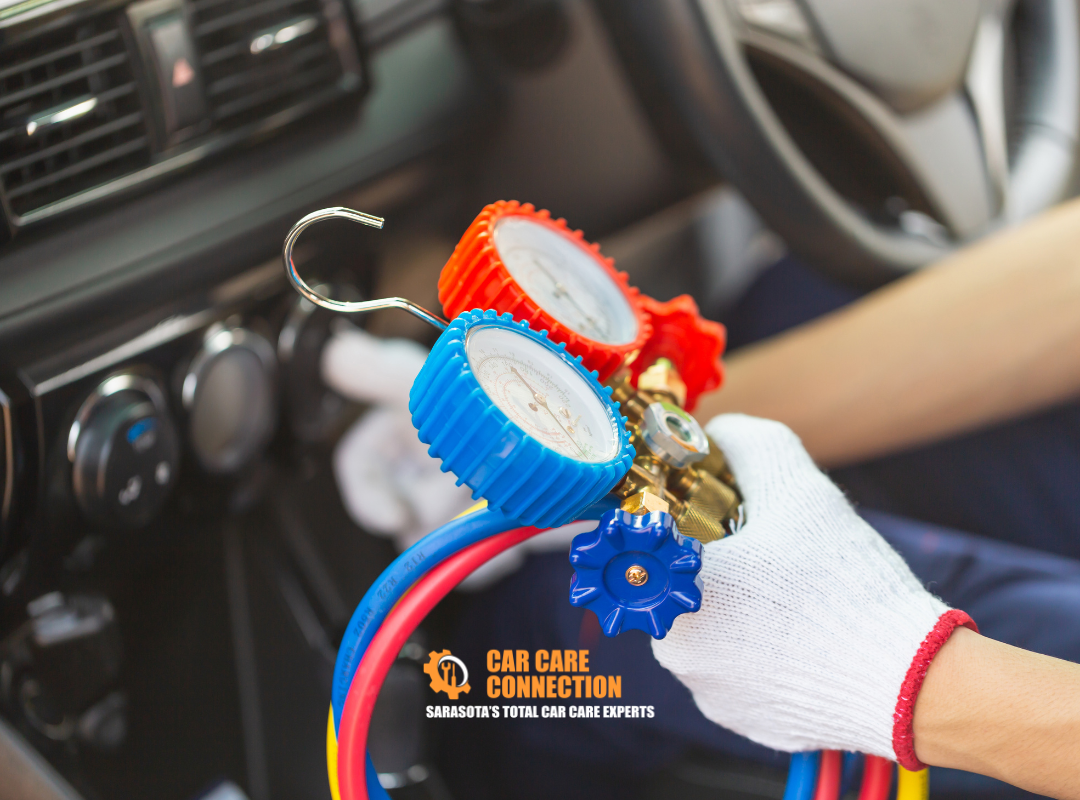
Refrigerant does not evaporate or burn off during normal operation. If your system is low on refrigerant, there is a leak. That is not a theory; it is how the system works. A closed loop that is losing refrigerant has a breach somewhere, and adding refrigerant without finding and repairing that breach means the new charge will leak out just as the previous one did.
Refrigerant leaks develop in several predictable locations. Schrader valves, the service ports used during charging, develop internal seal wear over time and allow slow refrigerant loss. O-rings at hose fittings and component connections degrade under heat cycling and become brittle, allowing seepage at connection points. The condenser, mounted at the front of the vehicle behind the grille, is vulnerable to road debris impact that can create pinhole leaks in its aluminum core.
Each of these failure points requires a different repair. A Schrader valve replacement is a minor service. A condenser replacement is a more involved job. Identifying which one is causing the loss requires a proper leak inspection; UV dye testing, electronic leak detection, or nitrogen pressure testing, depending on the system and the suspected location. A shop that skips this step and recharges the system is billing for a service that will not solve the problem.
The Condenser and Evaporator: What They Do and How They Fail in Florida
Most drivers know the compressor by name because it is the component that fails most dramatically and expensively. Fewer know the condenser and evaporator, which is unfortunate because both are common failure points in Florida vehicles, and each produces symptoms that are distinct from a compressor or refrigerant problem.
The condenser sits at the front of the vehicle and releases the heat that the refrigerant has absorbed from the cabin. It looks similar to a small radiator. In Sarasota, the condenser faces specific risks: road debris on US-41 and construction zones can cause impact damage, and the salt-air environment accelerates corrosion of its aluminum fins and core over time. A partially blocked or damaged condenser reduces the system’s ability to dissipate heat, causing high-side pressure to rise and the system to underperform even when refrigerant levels are correct.
The evaporator sits inside the dashboard and does the opposite; it absorbs heat from the cabin air, producing the cold air you feel from the vents. Florida’s humidity means the evaporator is continuously condensing significant amounts of moisture. Over time, that moisture environment promotes microbial growth on the evaporator surface, which reduces airflow and produces the musty odor described as dirty sock syndrome. A restricted evaporator reduces cooling output even when everything else in the system is functioning correctly.
The symptom profiles are different. A condenser problem typically shows up as warm air under highway driving conditions (where airflow through the condenser is higher) that worsens in slow traffic. An evaporator issue typically shows up as reduced airflow volume and odor rather than a temperature problem. Neither symptom is the same as “AC not cold,” which is why an accurate diagnosis requires more than connecting a manifold gauge set to the service ports.
For a complete overview of how your vehicle’s AC system works and what regular maintenance involves, visit our AC maintenance and service page. For specific information on the refrigerant circuit and how the Freon system operates, see our Freon system service page.
AC Component Symptoms at a Glance
| Component | What It Does | Failure Symptoms | Florida Risk Factor |
|---|---|---|---|
| Compressor | Pressurizes refrigerant to drive the cooling cycle | No cold air, loud noise on engagement, clutch not engaging | Year-round operation accelerates wear; low refrigerant causes seizure |
| Condenser | Releases heat from refrigerant to outside air | Warm air in slow traffic, high-side pressure codes | Road debris damage, salt-air corrosion of aluminum core |
| Evaporator | Absorbs cabin heat, produces cold air at vents | Reduced airflow, musty odor, weak cooling despite correct pressure | Humidity drives microbial growth; mold restricts airflow |
| Expansion Valve / Orifice Tube | Regulates refrigerant flow into evaporator | Inconsistent cooling, icing at evaporator, pressure fluctuations | Contaminated refrigerant from deferred service accelerates blockage |
| Cabin Air Filter | Filters air before it reaches the evaporator | Reduced vent airflow, increased blower motor strain | Coastal pollen and humidity load filters faster than inland climates |
The Compressor Failure Scenario: What Deferred AC Service Actually Costs
This is the scenario we see most often at Car Care Connection when a driver has been putting off AC service through a Florida summer.
The system starts blowing slightly less cold in May. The driver attributes it to the heat and waits. By July, the AC is noticeably underperforming. A recharge at a quick-service shop buys two weeks of improvement before the system is warm again. September arrives and the compressor is making noise. By the time the vehicle comes in for diagnosis, the refrigerant is gone, the compressor has been running with inadequate lubrication for months, and the internal damage is confirmed.
The repair scope at that point is not a recharge. It is a compressor replacement, a system flush to remove metal debris from the failed compressor, a new receiver-drier, a leak repair at the original source, and a recharge. Every one of those line items could have been avoided or reduced if the leak had been diagnosed and repaired in May.
Refrigerant carries the compressor oil that lubricates internal components. A system low on refrigerant is also low on that lubricant. The longer the compressor runs in that condition, the more internal wear accumulates. This is why compressor failure is consistently the outcome of long-term refrigerant loss, not just an unlucky coincidence.
Affordable AC repair in Sarasota is not the cheapest service available in the moment. It is the service that correctly identifies the problem the first time and prevents the larger repair that follows from ignoring it.
Visit our auto AC repair South Sarasota hub page for a complete overview of AC services at Car Care Connection. And check our current service coupons for any active offers before you schedule.
Frequently Asked Questions
Why does my car AC stop blowing cold in summer but work fine in spring?
Florida summer puts the AC system under maximum sustained load, high ambient temperatures, constant cabin cooling demand, and the AC compressor running nearly continuously. This operating condition exposes refrigerant leaks and component wear that go unnoticed in milder weather. A system that performs adequately in March may not have enough refrigerant or compressor capacity to keep up in July heat.
How do I know if I need an AC recharge or a full repair?
A recharge without a leak inspection is appropriate only when a system has been dormant for an extended period and has lost refrigerant through normal seal permeation, a slow process that typically takes several years. If your system was working normally and has lost cooling capacity within a season or two, there is a leak that needs to be found and repaired before recharging. The recharge itself will confirm whether the system holds pressure, but only a leak inspection identifies where and why it is losing refrigerant.
What is the most expensive car AC repair?
Compressor replacement is consistently the most costly AC repair, particularly when the failure results from prolonged refrigerant loss. When a compressor fails internally, metal debris circulates through the system and contaminates the condenser, expansion valve, and lines, requiring a full system flush and component replacement in addition to the compressor itself. This outcome is almost always preceded by a refrigerant leak that was not diagnosed and repaired in its early stage.
Is affordable AC repair in Sarasota the same as cheap AC repair?
Not at all. Affordable means the repair is correctly scoped and priced fairly for the work performed. Cheap often means a recharge without a leak inspection, parts replaced based on codes rather than confirmed diagnosis, or labor shortcuts that result in the same problem returning within weeks. The most affordable repair is the one that fixes the actual problem the first time — which requires a proper diagnosis first.
